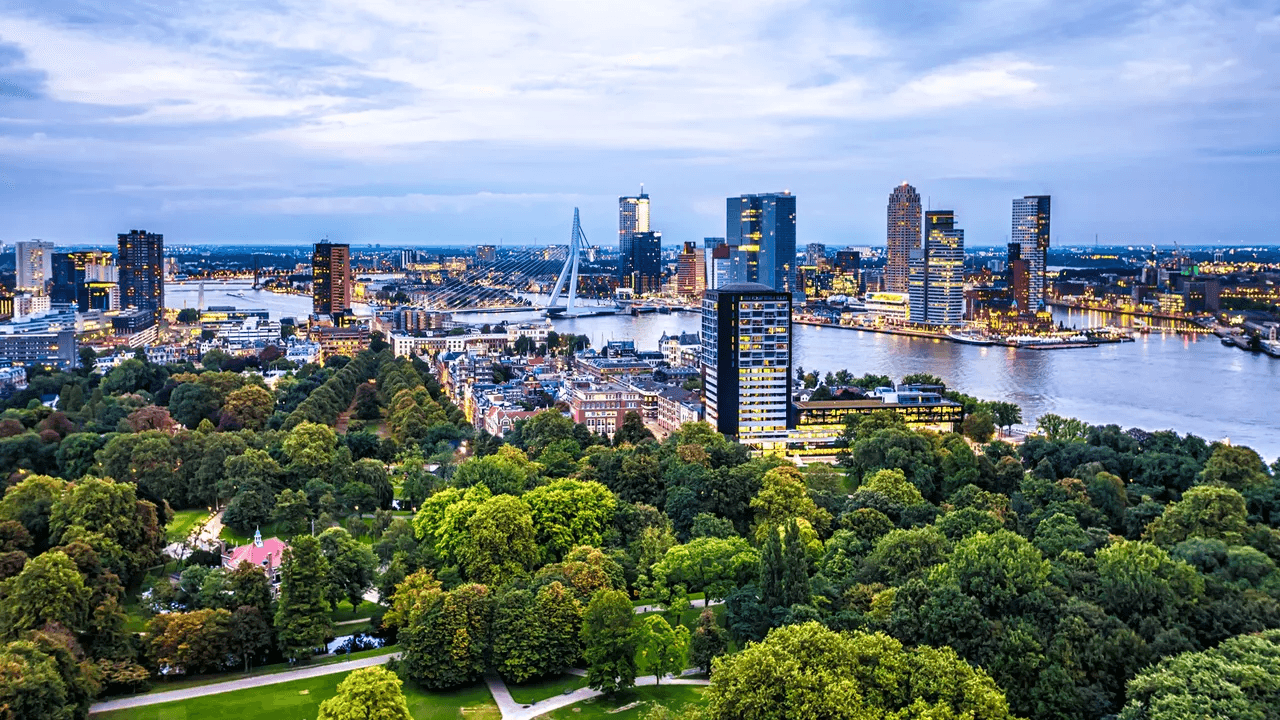
A few days after the bombing of Rotterdam (14 May 1940) and the capitulation (15 May 1940), city architect Willem Gerrit Witteveen was commissioned to design a plan for the reconstruction of the city. The speed with which both the commission was granted and the plan was designed is striking. This sense of urgency was primarily driven by the city council’s fear that the Nazis would present their own design. They were expected to transform Rotterdam into a Greater Germanic port city, in line with the urban planning vision of Albert Speer.
Who was the master mind of the Brave Decision?
Witteveen’s plan received considerable criticism during the war from several architects, including Van den Broek and Maaskant. They found support among a group of industrialists and businessmen led by C.H. van der Leeuw. In 1944, Cornelis van Traa was ultimately asked to adapt the plan to reflect the modernist ideas of this group of architects, with the approval of the Rotterdam business community.
What was the impact or result of this Brave Decision?
Much has been written about the quality of both Witteveen’s and Van Traa plans. But perhaps most remarkable was the way in which the reconstruction plans for the devastated city were shared with the inhabitants of Rotterdam. The press was enthusiastic: “Rotterdam, roll up your sleeves! A great task lies ahead,” headlined daily newspaper Het Vrije Volk. An exhibition was organized at Museum Boijmans van Beuningen, and the urban vision was brilliantly illustrated in the widely distributed brochure Het nieuwe hart van Rotterdam (The New Heart of Rotterdam). In this way, the people of Rotterdam were made part of this enormous undertaking.